


For professional makeup artists, beauty brands, and mobile beauty service teams, lighting and organization are essential to an efficient workspace. A makeup case with lights combines cosmetic storage with integrated illumination, helping professionals work in studios, backstage areas, salons, and on-location environments where lighting conditions may vary.
For businesses developing or sourcing professional beauty equipment, selecting the right design involves more than adding LEDs to a storage case. Mirror configuration, brightness adjustment, interior organization, structural durability, and portability all influence the final product. Understanding these features helps procurement teams evaluate suitable designs and identify customization opportunities for different professional applications.

1. Why a Makeup Case with Lights Matters for Professional Use
Professional makeup application often takes place in environments without consistent natural lighting. Wedding venues, photography studios, backstage areas, and temporary workstations may have different illumination conditions, making it difficult to assess makeup colors accurately.
A makeup case with lights integrates illumination into the working setup, reducing reliance on separate lighting equipment. When combined with a suitable mirror and organized storage, it can create a more convenient workstation for professionals who move between locations.
For beauty brands, salons, and companies supplying professional makeup equipment, this integrated design also offers opportunities to develop products for specific user groups. A compact case may suit freelance artists, while a larger rolling model may better accommodate teams carrying extensive cosmetic collections and tools.
The right configuration depends on the working environment, required storage capacity, transportation frequency, and intended customer segment.
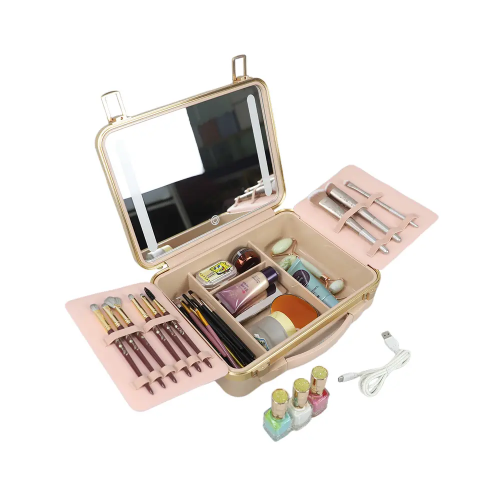
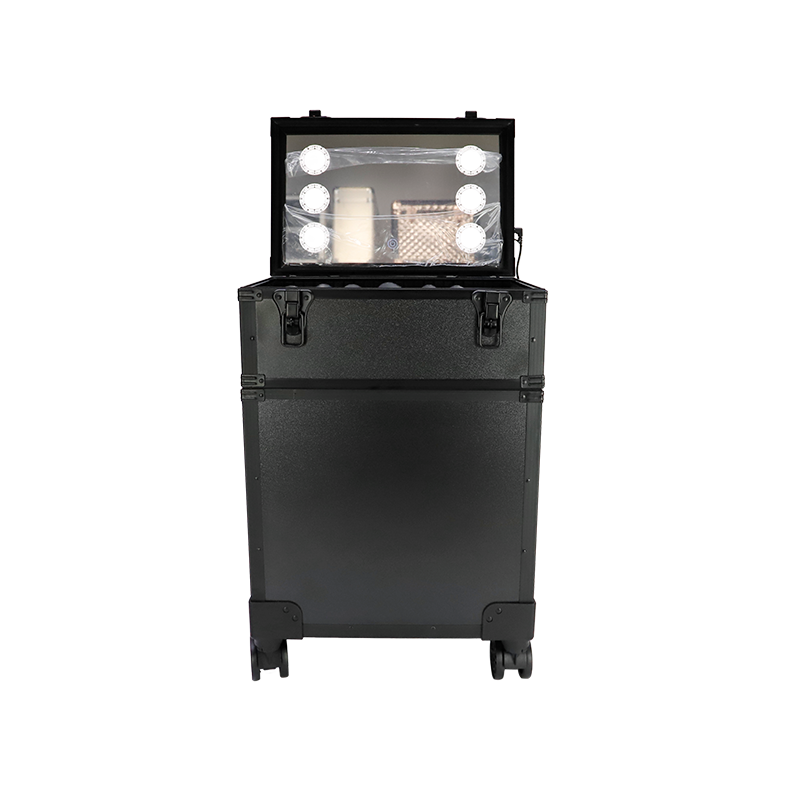
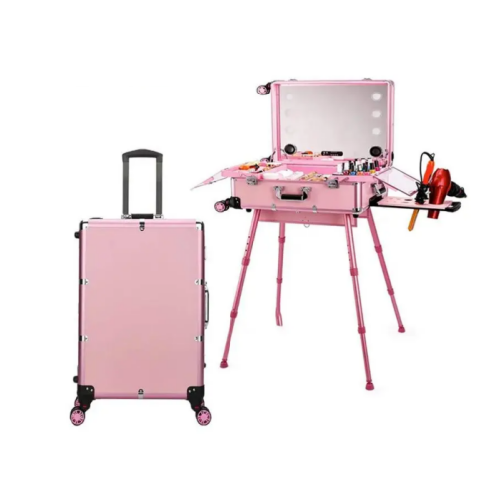
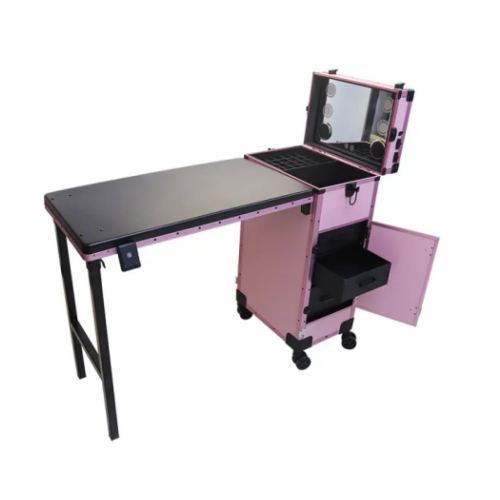
2. LED Makeup Case Lighting: Features That Matter
Lighting performance is one of the most important considerations when developing an LED makeup case. The arrangement of the lights, available adjustment settings, and ease of operation all influence the user experience.
Adjustable Color Temperature
Different lighting environments can affect how makeup colors appear. Some cases provide warm, neutral, and cool lighting modes, allowing users to evaluate their work under different illumination conditions.
For professional applications, adjustable color temperature can be a useful feature for artists working across studios, events, and client locations. However, changing the color temperature alone does not guarantee accurate color assessment. Light quality, color rendering performance, and surrounding illumination also matter.
Businesses evaluating suppliers should confirm the available lighting modes and assess whether they suit the intended application.
Brightness Adjustment and Light Distribution
Adjustable brightness allows users to adapt illumination to different working environments. Even light distribution around the mirror can also help reduce distracting shadows during makeup application.
The number of LED lights is not the only measure of performance. Their positioning, spacing, brightness range, and proximity to the user's face should be considered together.
For an LED makeup case intended for professional use, testing the actual lighting arrangement is more useful than relying solely on product descriptions.
Power Supply and Control Design
Lighting systems require a practical power solution. Depending on the design, a case may use a rechargeable battery, replaceable batteries, or an external power connection.
Procurement teams should confirm charging requirements, operating time where applicable, control placement, and access to electrical components for maintenance. These details are particularly important for mobile professionals who may not have convenient access to power during assignments.
3. Interior Organization for Cosmetics and Professional Tools
Lighting improves the working environment, but storage design determines how efficiently professionals can access their products. A well-organized case should accommodate the cosmetics and tools required for the intended application without making the overall structure unnecessarily bulky.
Adjustable Compartments and Trays
Adjustable dividers allow users to organize products of different sizes, including palettes, bottles, compact powders, and accessories. Removable trays can separate frequently used items from products stored for less frequent access.
For businesses supplying different professional user groups, customizable compartments can accommodate varying product assortments without requiring a completely different exterior design for every configuration.
Brush Holders and Accessory Storage
Dedicated brush holders help keep brushes organized and separate from other products. Additional compartments can accommodate applicators, small tools, and accessories.
The interior lining should also be practical to clean, particularly when the case is used frequently in commercial environments. Businesses should evaluate the durability of the lining, the security of dividers, and the ease of replacing or rearranging internal components.
Balancing Storage and Portability
Increasing storage capacity can also increase the case's size and weight. A compact design may be suitable for mobile artists who carry a limited selection of products, while a larger case may better support professional teams with extensive equipment requirements.
The objective is to match storage capacity to the actual workflow rather than maximizing internal volume without considering portability.
4. Materials, Portability, and Protection
The exterior structure affects durability, appearance, weight, and cost. Aluminum-framed cases can provide a structured design with customizable panels, while ABS and other panel materials may suit different weight, appearance, and budget requirements.
Hardware selection also influences everyday usability. Handles, locks, hinges, reinforced corners, and trolley components should be evaluated according to the case's expected transportation frequency and load.
For mobile beauty professionals, rolling designs with telescopic handles can make larger equipment sets easier to transport. Compact handheld models may be more suitable when storage capacity and mobility must be balanced within a smaller footprint.
Protection is particularly important for a makeup case with lights because the product combines cosmetics storage with electrical components and a mirror. Internal clearance, secure component mounting, and appropriate protective packaging should be considered during design and production.

For businesses comparing different case structures and applications, our Best Makeup Cases for Professional Makeup Artists: 2026 Review explores aluminum cosmetic cases, illuminated makeup cases, and rolling designs for different professional requirements.
5. Design Considerations for Custom Makeup Case Projects
When sourcing a custom makeup case, businesses should begin by defining the target market and intended working environment. A product designed for beauty retail, professional makeup services, or salon use may require different storage layouts, lighting functions, and exterior specifications.
Before production, procurement teams should confirm several key requirements:
- Lighting specifications: Available color temperature modes, brightness adjustment, control design, and power supply.
- Mirror configuration: Mirror dimensions, mounting method, opening angle, and protection during transportation.
- Interior layout: Compartment sizes, removable dividers, brush holders, trays, and accessory storage.
- Exterior customization: Dimensions, panel materials, colors, hardware, and logo placement.
- Production requirements: Sample approval, minimum order quantity, lead time, and consistency across production batches.
An experienced manufacturer can help assess how these requirements interact. For example, a larger mirror may affect the lid structure, while additional trays may influence the case's overall dimensions and weight.
For OEM and ODM projects, reviewing a sample before mass production can help verify lighting operation, mirror stability, storage capacity, and ease of use. Clear specifications also help reduce misunderstandings during production and improve consistency across repeat orders.
Businesses evaluating different designs can explore our custom makeup case range to review available product configurations and discuss requirements for their own projects.
Selecting the Right Makeup Case with Lights
A well-designed makeup case with lights combines practical illumination, a suitable mirror, organized storage, and a durable structure. Each feature should support the intended working environment rather than add complexity without a clear purpose.
For beauty brands, professional service providers, and commercial buyers, the most effective approach is to define user requirements first and then evaluate lighting, materials, storage, and portability as one integrated design.
Contact Lucky Case to discuss your project specifications, customization requirements, and production needs for a professional makeup case.
Post time: Oct-23-2026
